CNN with the MNIST Dataset

Here, I build a simple convolutional neural network (CNN) to classify the MNIST digits dataset. I use the Keras API with the TensorFlow backend. I use the sequential model with two convolutional layers and two max pooling layers. I then flatten the output of the second max pooling layer and use two dense layers to classify the digits. I use the Adam optimizer and the sparse categorial cross entropy loss function.

In addition, I illustrate the raw data as both a matrix and as an image. I also illustrate the dataset sizes. Finally, I illustrate the accuracy and loss of the model as a function of the epoch number and a confusion matrix of the results.

Below is a diagram of the CNN model.
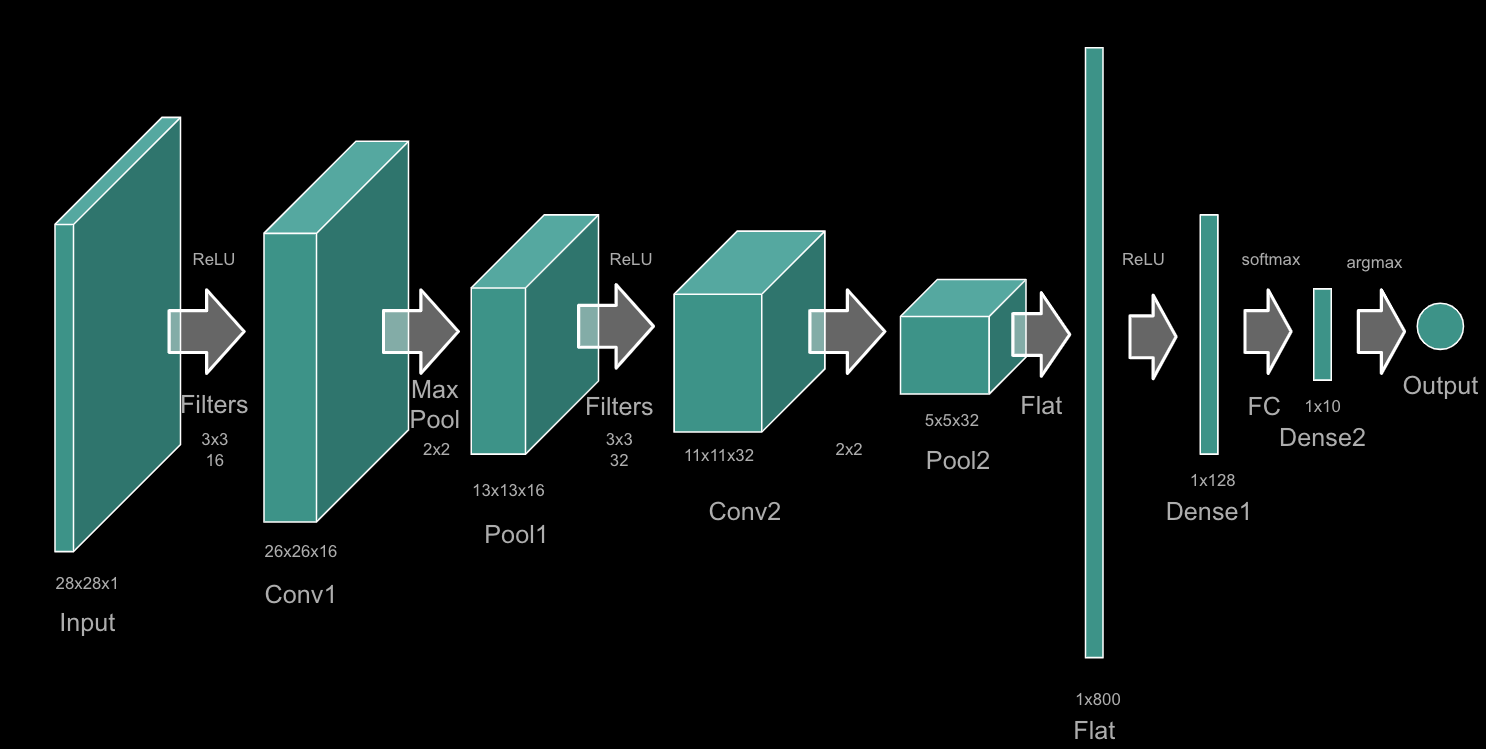
CNN Model

Import Libraries

In [32]:
# import libraries
import numpy as np
import tensorflow as tf
from tensorflow import keras
from keras import layers, models
import matplotlib.pyplot as plt
from sklearn.metrics import confusion_matrix

Import MNIST Dataset

In [5]:
# import mnist data
data = tf.keras.datasets.mnist.load_data(path="mnist.npz")
In [12]:
# split the data into test/train
x_train, y_train = data[0]
x_test, y_test = data[1]
In [14]:
# print the first value of x_train as a matrix
print('The first value of x_train as a matrix:')
print(x_train[0])
The first value of x_train as a matrix:
[[  0   0   0   0   0   0   0   0   0   0   0   0   0   0   0   0   0   0
    0   0   0   0   0   0   0   0   0   0]
 [  0   0   0   0   0   0   0   0   0   0   0   0   0   0   0   0   0   0
    0   0   0   0   0   0   0   0   0   0]
 [  0   0   0   0   0   0   0   0   0   0   0   0   0   0   0   0   0   0
    0   0   0   0   0   0   0   0   0   0]
 [  0   0   0   0   0   0   0   0   0   0   0   0   0   0   0   0   0   0
    0   0   0   0   0   0   0   0   0   0]
 [  0   0   0   0   0   0   0   0   0   0   0   0   0   0   0   0   0   0
    0   0   0   0   0   0   0   0   0   0]
 [  0   0   0   0   0   0   0   0   0   0   0   0   3  18  18  18 126 136
  175  26 166 255 247 127   0   0   0   0]
 [  0   0   0   0   0   0   0   0  30  36  94 154 170 253 253 253 253 253
  225 172 253 242 195  64   0   0   0   0]
 [  0   0   0   0   0   0   0  49 238 253 253 253 253 253 253 253 253 251
   93  82  82  56  39   0   0   0   0   0]
 [  0   0   0   0   0   0   0  18 219 253 253 253 253 253 198 182 247 241
    0   0   0   0   0   0   0   0   0   0]
 [  0   0   0   0   0   0   0   0  80 156 107 253 253 205  11   0  43 154
    0   0   0   0   0   0   0   0   0   0]
 [  0   0   0   0   0   0   0   0   0  14   1 154 253  90   0   0   0   0
    0   0   0   0   0   0   0   0   0   0]
 [  0   0   0   0   0   0   0   0   0   0   0 139 253 190   2   0   0   0
    0   0   0   0   0   0   0   0   0   0]
 [  0   0   0   0   0   0   0   0   0   0   0  11 190 253  70   0   0   0
    0   0   0   0   0   0   0   0   0   0]
 [  0   0   0   0   0   0   0   0   0   0   0   0  35 241 225 160 108   1
    0   0   0   0   0   0   0   0   0   0]
 [  0   0   0   0   0   0   0   0   0   0   0   0   0  81 240 253 253 119
   25   0   0   0   0   0   0   0   0   0]
 [  0   0   0   0   0   0   0   0   0   0   0   0   0   0  45 186 253 253
  150  27   0   0   0   0   0   0   0   0]
 [  0   0   0   0   0   0   0   0   0   0   0   0   0   0   0  16  93 252
  253 187   0   0   0   0   0   0   0   0]
 [  0   0   0   0   0   0   0   0   0   0   0   0   0   0   0   0   0 249
  253 249  64   0   0   0   0   0   0   0]
 [  0   0   0   0   0   0   0   0   0   0   0   0   0   0  46 130 183 253
  253 207   2   0   0   0   0   0   0   0]
 [  0   0   0   0   0   0   0   0   0   0   0   0  39 148 229 253 253 253
  250 182   0   0   0   0   0   0   0   0]
 [  0   0   0   0   0   0   0   0   0   0  24 114 221 253 253 253 253 201
   78   0   0   0   0   0   0   0   0   0]
 [  0   0   0   0   0   0   0   0  23  66 213 253 253 253 253 198  81   2
    0   0   0   0   0   0   0   0   0   0]
 [  0   0   0   0   0   0  18 171 219 253 253 253 253 195  80   9   0   0
    0   0   0   0   0   0   0   0   0   0]
 [  0   0   0   0  55 172 226 253 253 253 253 244 133  11   0   0   0   0
    0   0   0   0   0   0   0   0   0   0]
 [  0   0   0   0 136 253 253 253 212 135 132  16   0   0   0   0   0   0
    0   0   0   0   0   0   0   0   0   0]
 [  0   0   0   0   0   0   0   0   0   0   0   0   0   0   0   0   0   0
    0   0   0   0   0   0   0   0   0   0]
 [  0   0   0   0   0   0   0   0   0   0   0   0   0   0   0   0   0   0
    0   0   0   0   0   0   0   0   0   0]
 [  0   0   0   0   0   0   0   0   0   0   0   0   0   0   0   0   0   0
    0   0   0   0   0   0   0   0   0   0]]
In [17]:
# print the first value of x_train as an image
print('The first value of x_train as an image:')
plt.imshow(x_train[0], cmap=plt.cm.binary)
plt.show()
The first value of x_train as an image:
In [18]:
# normalize the data
x_train = x_train / 255.0
x_test = x_test / 255.0

Build the CNN Model with Keras

In [45]:
# clear the session
tf.keras.backend.clear_session()

# initialize the model
cnn = keras.Sequential()
In [46]:
# add layers

# first convolutional layer
cnn.add(layers.Conv2D(
    filters=16, 
    kernel_size=(3, 3), 
    activation='relu', 
    input_shape=(28, 28, 1),
    padding='valid' # don't add padding, default value
))

# first pooling layer
cnn.add(layers.MaxPooling2D(
    pool_size=(2, 2)
))

# second convolutional layer
cnn.add(layers.Conv2D(
    filters=32, 
    kernel_size=(3, 3), 
    activation='relu',
    padding='valid' # don't add padding, default value
))

# second pooling layer
cnn.add(layers.MaxPooling2D(
    pool_size=(2, 2)
))

# flatten the data
cnn.add(layers.Flatten())

# add a dense layer
cnn.add(layers.Dense(
    units=128, 
    activation='relu'
))

# add an output layer
cnn.add(layers.Dense(
    units=10, 
    activation='softmax'
))

# compile the model
cnn.compile(
    loss = 'sparse_categorical_crossentropy',
    optimizer = 'adam',
    metrics = ['accuracy']
)

cnn.summary()
Model: "sequential"
_________________________________________________________________
 Layer (type)                Output Shape              Param #   
=================================================================
 conv2d (Conv2D)             (None, 26, 26, 16)        160       
                                                                 
 max_pooling2d (MaxPooling2  (None, 13, 13, 16)        0         
 D)                                                              
                                                                 
 conv2d_1 (Conv2D)           (None, 11, 11, 32)        4640      
                                                                 
 max_pooling2d_1 (MaxPoolin  (None, 5, 5, 32)          0         
 g2D)                                                            
                                                                 
 flatten (Flatten)           (None, 800)               0         
                                                                 
 dense (Dense)               (None, 128)               102528    
                                                                 
 dense_1 (Dense)             (None, 10)                1290      
                                                                 
=================================================================
Total params: 108618 (424.29 KB)
Trainable params: 108618 (424.29 KB)
Non-trainable params: 0 (0.00 Byte)
_________________________________________________________________

Train the Model

In [28]:
# train the model
history = cnn.fit(
    x_train,
    y_train,
    epochs=10,
    batch_size=128,
    validation_data=(x_test, y_test),
    verbose=1
)
Epoch 1/10
469/469 [==============================] - 15s 30ms/step - loss: 0.2679 - accuracy: 0.9272 - val_loss: 0.0659 - val_accuracy: 0.9803
Epoch 2/10
469/469 [==============================] - 15s 31ms/step - loss: 0.0630 - accuracy: 0.9814 - val_loss: 0.0438 - val_accuracy: 0.9849
Epoch 3/10
469/469 [==============================] - 17s 37ms/step - loss: 0.0433 - accuracy: 0.9871 - val_loss: 0.0346 - val_accuracy: 0.9882
Epoch 4/10
469/469 [==============================] - 16s 33ms/step - loss: 0.0357 - accuracy: 0.9888 - val_loss: 0.0296 - val_accuracy: 0.9907
Epoch 5/10
469/469 [==============================] - 14s 30ms/step - loss: 0.0288 - accuracy: 0.9909 - val_loss: 0.0330 - val_accuracy: 0.9889
Epoch 6/10
469/469 [==============================] - 13s 27ms/step - loss: 0.0243 - accuracy: 0.9926 - val_loss: 0.0312 - val_accuracy: 0.9897
Epoch 7/10
469/469 [==============================] - 14s 30ms/step - loss: 0.0197 - accuracy: 0.9938 - val_loss: 0.0306 - val_accuracy: 0.9902
Epoch 8/10
469/469 [==============================] - 15s 31ms/step - loss: 0.0152 - accuracy: 0.9952 - val_loss: 0.0329 - val_accuracy: 0.9903
Epoch 9/10
469/469 [==============================] - 14s 30ms/step - loss: 0.0132 - accuracy: 0.9955 - val_loss: 0.0268 - val_accuracy: 0.9904
Epoch 10/10
469/469 [==============================] - 14s 29ms/step - loss: 0.0118 - accuracy: 0.9961 - val_loss: 0.0328 - val_accuracy: 0.9903

Evaluate the Model

In [29]:
# evaluate the model
test_loss, test_accuracy = cnn.evaluate(x_test, y_test, verbose=1)
predictions = cnn.predict(x_test)
313/313 [==============================] - 1s 3ms/step - loss: 0.0328 - accuracy: 0.9903
313/313 [==============================] - 1s 3ms/step
In [30]:
# visualize the accuracy and loss over the epochs
plt.plot(history.history['accuracy'])
plt.plot(history.history['val_accuracy'])
plt.title('CNN Accuracy')
plt.ylabel('Accuracy')
plt.xlabel('Epoch')
plt.legend(['Train', 'Test'], loc='upper left')
plt.show()
In [35]:
# create a confusion matrix
# https://scikit-learn.org/stable/modules/generated/sklearn.metrics.confusion_matrix.html
cm = confusion_matrix(y_test, predictions.argmax(axis=1))
print('Confusion Matrix Values: \n', cm)

# number of classes
num_classes = 10

# plot a pretty confusion matrix
# https://scikit-learn.org/stable/auto_examples/model_selection/plot_confusion_matrix.html
plt.imshow(cm, cmap=plt.cm.Blues)
plt.xlabel("Predicted labels")
plt.ylabel("True labels")
plt.xticks(np.arange(num_classes))
plt.yticks(np.arange(num_classes))
plt.title("Confusion matrix")
plt.colorbar()
plt.show()
Confusion Matrix Values: 
 [[ 976    0    0    0    0    0    1    1    1    1]
 [   0 1129    4    2    0    0    0    0    0    0]
 [   0    0 1025    1    1    0    0    5    0    0]
 [   0    0    3 1005    0    2    0    0    0    0]
 [   0    1    0    0  975    0    1    0    0    5]
 [   2    0    1    8    0  877    1    0    1    2]
 [   2    5    0    1    2    2  944    0    2    0]
 [   0    2   10    3    0    0    0 1008    0    5]
 [   3    0    4    1    0    0    0    0  965    1]
 [   0    0    0    0    7    2    0    1    0  999]]

Ablation

To peer into our model, let's visualize some of the kernels and the feature maps they produce. We'll start with the first convolutional layer. We'll visualize the kernels as images and the feature maps as heatmaps. We'll also visualize the kernels and feature maps for the second convolutional layer.

In [38]:
# visualize the first 16 kernels
# https://keras.io/examples/vision/visualizing_what_convnets_learn/
layer_name = 'conv2d'
filter_index = 0
layer = cnn.get_layer(name=layer_name)
layer_weights = layer.get_weights()[0]
for i in range(16):
    plt.subplot(4, 4, i + 1)
    plt.imshow(layer_weights[:, :, 0, i], cmap='gray')
    plt.axis('off')
plt.show()
In [39]:
# visualize the 32 kernels from the second vonvolutional layer
# https://keras.io/examples/vision/visualizing_what_convnets_learn/
layer_name = 'conv2d_1'
filter_index = 0
layer = cnn.get_layer(name=layer_name)
layer_weights = layer.get_weights()[0]
for i in range(32):
    plt.subplot(8, 4, i + 1)
    plt.imshow(layer_weights[:, :, 0, i], cmap='gray')
    plt.axis('off')
plt.show()

Now let's visualize what happens to a digit as it passes through the network. Below are a few feature maps from the first convolutional layer that show what happens to the input digit as its convolved and activated. We can see that the network is picking up on the edges of the digit.

In [42]:
# https://keras.io/examples/vision/visualizing_what_convnets_learn/
layer_outputs = [layer.output for layer in cnn.layers[:4]]
activation_model = models.Model(inputs=cnn.input, outputs=layer_outputs)
activations = activation_model.predict(x_test[0].reshape(1, 28, 28, 1))
first_layer_activation = activations[0]
plt.matshow(first_layer_activation[0, :, :, 4], cmap='viridis')
plt.show()
plt.matshow(first_layer_activation[0, :, :, 7], cmap='viridis')
plt.show()
plt.matshow(first_layer_activation[0, :, :, 10], cmap='viridis')
plt.show()
plt.matshow(first_layer_activation[0, :, :, 13], cmap='viridis')
plt.show()
1/1 [==============================] - 0s 62ms/step

Now let's look at some of the outputs from the second convolutional layer. We can see that the network is picking up on the features of the digit.

In [48]:
# visualize the outputs from the second convolutional layer
# https://keras.io/examples/vision/visualizing_what_convnets_learn/
layer_outputs = [layer.output for layer in cnn.layers[:4]]
activation_model = models.Model(inputs=cnn.input, outputs=layer_outputs)
activations = activation_model.predict(x_test[0].reshape(1, 28, 28, 1))
second_layer_activation = activations[2]
plt.matshow(second_layer_activation[0, :, :, 4], cmap='viridis')
plt.show()
plt.matshow(second_layer_activation[0, :, :, 7], cmap='viridis')
plt.show()
plt.matshow(second_layer_activation[0, :, :, 10], cmap='viridis')
plt.show()
plt.matshow(second_layer_activation[0, :, :, 13], cmap='viridis')
plt.show()
WARNING:tensorflow:6 out of the last 318 calls to <function Model.make_predict_function.<locals>.predict_function at 0x7fa54f955790> triggered tf.function retracing. Tracing is expensive and the excessive number of tracings could be due to (1) creating @tf.function repeatedly in a loop, (2) passing tensors with different shapes, (3) passing Python objects instead of tensors. For (1), please define your @tf.function outside of the loop. For (2), @tf.function has reduce_retracing=True option that can avoid unnecessary retracing. For (3), please refer to https://www.tensorflow.org/guide/function#controlling_retracing and https://www.tensorflow.org/api_docs/python/tf/function for  more details.
1/1 [==============================] - 0s 61ms/step

Results

Overall, the model achieves an accuracy of 99.03% on the test dataset. This is even better than the previous ANN architecturem which had an accuracy of 98.04%. Though it is just 1% better, the error rate has been halved, which is quite impressive. Even though this CNN model had one fewer dense layers than the ANN model (2 vs. 3), it still performed better. This is because the CNN model extracts featuires

Export as HTML Page

In [2]:
# export to HTML for webpage
import os

# os.system('jupyter nbconvert --to html mod1.ipynb')
os.system('jupyter nbconvert --to html pt2_cnn.ipynb --HTMLExporter.theme=dark')
[NbConvertApp] Converting notebook pt2_cnn.ipynb to html
[NbConvertApp] Writing 586133 bytes to pt2_cnn.html
Out[2]:
0